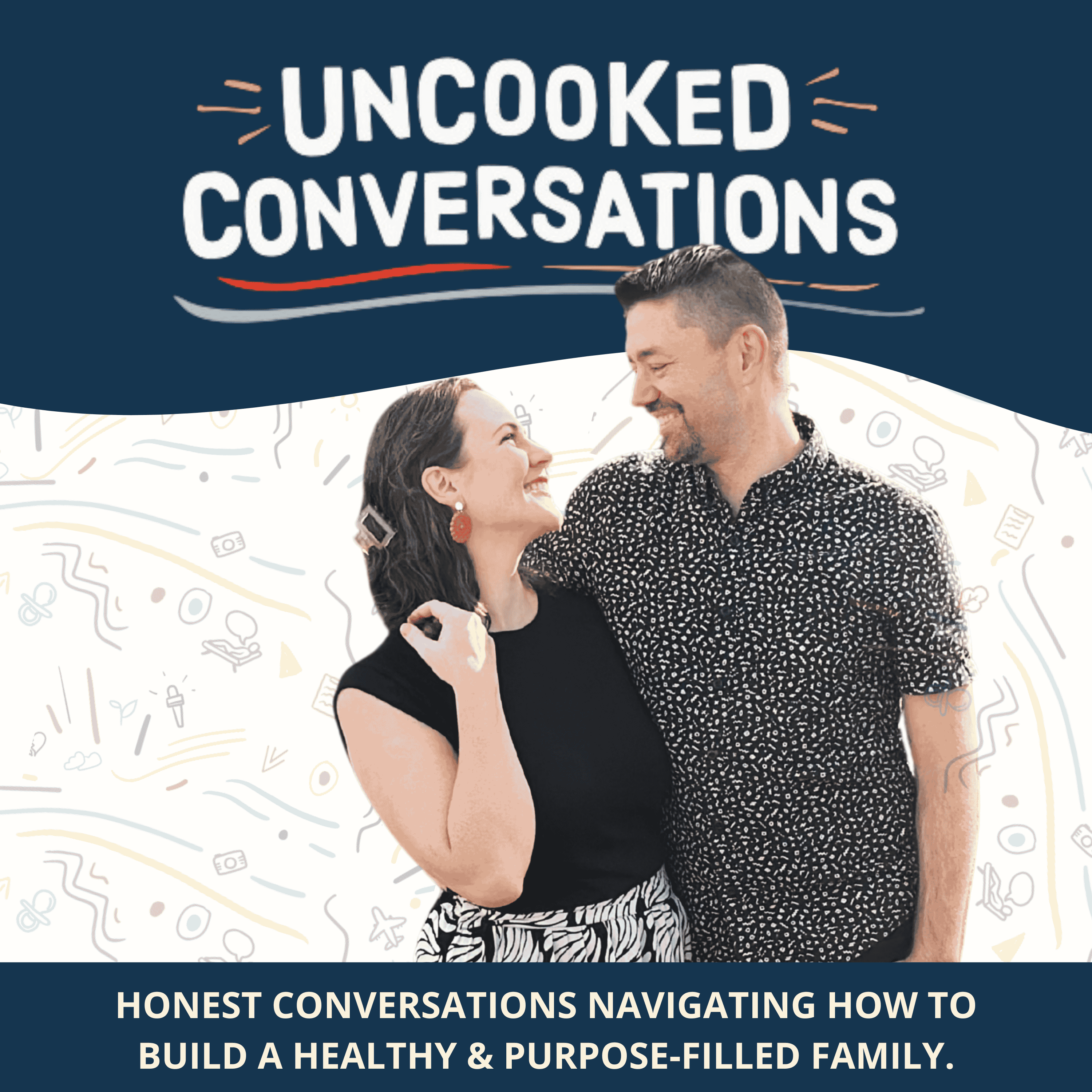
#019: A New Era of Uncooked Conversations: Why We’re Back and What We’re Building Now
LINKS MENTIONED:
SUBSTACK: https://aliparnell.substack.com/
INSTAGRAM: www.instagram.com/integratedfamily
ABOUT THIS EPISODE:
Our inaugural episode of season 3 serves as a pivotal moment for UnCooked Conversations. Paul & Ali reestablish their platform and clarify their mission and then delve into the intricacies of marriage, parenting, and the challenges that arise from navigating a multifaceted family life.
Their conversation highlights a Christ-centered approach to family dynamics, and they seek to empower fellow couples to break free from the cycles of dysfunction that may have characterized their upbringing. We provide insight into our personal journey, sharing the lessons we've learned through our own trials and tribulations, and we emphasize the importance of integrating both emotional intelligence and spiritual growth into our everyday lives. As we share our experiences, we also invite our listeners to consider the implications of their own family narratives, encouraging them to engage in a process of reflection and growth. We recognize that healing is not a linear path but rather a complex journey that requires ongoing commitment and intentionality. By embracing a holistic approach to family life, we aspire to equip our audience with the tools necessary to cultivate healthier relationships and foster a supportive community. Our discussions will encompass a range of topics, from addressing common marital challenges to exploring the nuances of parenting neurodiverse children, all aimed at fostering an environment that nurtures love, understanding, and resilience. Join us as we embark on this transformative journey together, seeking to build a legacy of wholeness and connection.
Takeaways:
- In this episode, we discuss our journey of relaunching the podcast after a significant hiatus, emphasizing the importance of clarity and focus in our messaging.
- We aim to support Christ-centered couples in breaking dysfunctional cycles and establishing healthy marriages and homes, drawing from our own experiences.
- The core mission of our podcast is to provide insights and tools to help families navigate challenges while fostering a healthy relational environment.
- We reflect on our personal growth and healing journey, highlighting the necessity of addressing deep-seated patterns inherited from our families of origin.
- Future episodes will delve into the complexities of marriage and family life, integrating psychological insights with spiritual principles for holistic health.
- Our commitment is to engage in meaningful conversations about faith, family, and personal growth, while creating a welcoming community for all listeners.
Transcript
Have you ever wondered, where have Paul and Ali been the past two years?
Speaker B:In this episode, we're sharing where we've been, what's changed in our family and work, why we're returning to the podcast, and the vision behind our new brand, the integrated family, and how it will serve you.
Speaker A:Welcome to Uncooked Conversations.
Speaker B:I'm Paul.
Speaker A:And I'm Allie.
We're founders of Integrated Family and parents of four boys.
Speaker B:Like many of you, we're doing the complicated work of healing what shaped us while building something healthier for our family.
Speaker A:Here we talk honestly about marriage, family systems, faith, neurodivergence, and building what we were never shown, because none of us.
Speaker B:Should have to walk this journey alone.
Speaker A:Well, hello everyone, and welcome back to Uncooked Conversations.
We are so thrilled to be back for season three, episode one.
Did you even know that we ended season two?
Speaker B:Wasn't it one episode?
Speaker A:No, we actually.
I think we maybe had seven episodes or something like that, but we're really excited to be back.
d Uncut conversations back in:We started in the midst of COVID and on a whim.
And when we started, it was very like, hey, let's just try this thing, do this thing, and we're coming back strong, let's put it that way.
Speaker B:So in this episode, we're going to talk about the relaunch of the podcast, the fact that we've built sort of an overarching brand, that the podcast and other resources will be now housed under the integrated family.
We're going to talk about our heart behind that, and we're also going to set up the overall season three, kind of tee it up, give you some vibes of what the future episodes are going to be like about and who they're for.
Speaker A:And so this episode is really that foundational episode.
So you're going to catch the vision of where we're headed and really what you can expect from us over the next many episodes to come, because our heart and intention is to just bring more focus and clarity to what we're doing here.
I think the episodes we've done in the past, we've loved and had so much fun making, and I think we're going to love and have so much fun making what we're going to be doing, but we also feel this pull towards bringing, I guess, just more focus to what we're doing because we actually feel like we have this burning message inside of us, if you will.
And I think that when we can center our energy around this core message, Then we're going to be able to actually help you guys more and just continue having fun making it.
So one of the big ideas, you know, I keep talking about, like the clarity and the messaging and seeing, centering our ideas, et cetera, but one of the things that we have gotten pretty clear on through lots of conversation between us in the background is who this is for and what we're trying to build.
And so the core phrase, I guess, is that we are focused on helping Christ centered couples break cycles, who want to build a healthy marriage and home that they never had.
And I want to break that down a little bit more for us.
We are definitely not trying to shoo away anyone who is not Christ centered.
We want any and everyone to listen, who finds us interesting and fun to listen to.
But we realize that for us in our own faith journey and what's important to us, we just cannot take that part out of us of talking about the Bible, talking about theology, talking about things that really matter to us from a spiritual perspective.
And so it's just got to be Christ centered.
That's just what it's got to be.
And then breaking cycles, like we both have come from very dysfunctional backgrounds, and that is our story of breaking cycles and changing the flow of what our template was that we were given and to shift those dynamics and build something better.
The second part of that is, you know, for Christ centered couples who want to build a healthy marriage and home that they never had.
So basically, if you're like us in any way, where you came from some kind of trauma, dysfunction, messy backgrounds that left you feeling not very whole as you entered adulthood and marriage and building a family and you're like, wait a second, something is not working here.
And then you're now trying to build something healthier, but you don't have that template.
That's really the core people that we are trying to help and support through our podcast.
Because I think it's a very nuanced group of people.
Like, there's a lot of nuance in walking out a Christ centered life, plus dealing with all the baggage that you have and how do we do that in a truly transformative and holistic way and not just like bypassing and put a smile on and let's go Jesus.
Speaker B:It could not be family oriented, it could be school oriented trauma and difficulty.
It could be just lack of skills, which was also a big part of our journey was having to learn conflict skills and communication skills and emotional management skills.
And we're going to be talking about a Lot of those different things and helping to kind of put those tools in your tool belt so that you can build a healthy relationship and whatever season you're in, eventually build a healthy family.
Speaker A:Yeah, I love that we're trying to get more focused so that our message can be really clear and distilled.
But we also would love anyone to listen.
You are welcome here.
Welcome back to Uncut Conversations if you are a long term OG listener, the 15 of you out there, and welcome to Uncut Conversations.
If this is your first time listening, we are so thrilled to have you with us and really excited to take you along for the journey.
And if you want to hear some of our old stuff, feel free to go back and listen.
last episode was published in:A lot has changed and grown, to say the least.
And we are not just talking about our vision for this podcast.
When I say that a lot has changed and grown because.
Speaker B:Because you have changed.
Speaker A:I changed and I grew and then I changed again.
last episode was published in: Speaker B:Well, we were so inspired by our messages and ideas, our own messages and ideas and others family ideas.
We were like, we should expand our family.
You know, we're really blessed to be able to do that.
And then we got a surprise because instead of getting one new member, we got a double dose, a little double dose of that surprise twins.
So we got identical twin boys, which if you haven't had twins, it's a miracle.
Speaker A:It is a miracle.
It is a miracle that you're still standing after they turn one.
Speaker B:Yes.
And it's beautiful and amazing and incredibly difficult.
And we had a lot of challenges during that time, which I know you've written some sub stacks on and go.
Speaker A:Check out my sub stack link in the description.
But you can read our whole detailed story there.
It is truly incredible and remarkable what we walked through, basically from getting pregnant, their delivery.
We had some complications anyway, won't go into all that, but it's definitely worth going and reading.
Speaker B:Yeah.
And I'm sure we'll talk about it on a future episode too.
We got pregnant, we found out it was twins.
That was crazy.
We had some complications.
Thankfully we overcame it, but the whole rest of the journey was very stressful.
And then Allie was able to birth twins.
They're healthy, they're in the NICU for a long time, not too long.
And now they're over one.
Speaker A:Even sitting here recording this, it's like, I didn't know if we were going to come back to uncooked conversations.
We've continued to talk about it over the past couple years, but so we ripped the band aid off and here we are.
So I guess that's a little bit about why we stepped back, expanding our family, doubling the amount of boys we have.
So now we've gone from two boys to four boys.
Speaker B:Some people add, we multiply, we multiply.
Speaker A:I guess we're in the business of multiplication.
I think also, you know, we just, I think, needed a little bit more time to distill.
Like, you know, we've already talked a lot about what we're going for with uncut conversations now, and I think we needed time to really pause and decide how to move forward, in addition to learning how to navigate as a family of six and all the responsibilities with it.
Speaker B:So let's talk a little bit about what has become more clear for us.
I think we had been focused on marriage, family, business, and everything in between.
And that's a lot to cover every week in an hour or less.
And I think because we are polymaths, we have our fingers in every cookie jar imaginable, it's really easy for us to talk kind of all over the place.
And so it took some time and effort and a lot of thinking to pull in the reins and go, well, if we were only able to give one thing that we think would ultimately set a family up for the best outcomes, what would that be?
And I would say it's a healthy marriage.
And so there's nothing more valuable besides maybe personal, spiritual walk in a marriage than having a healthy marriage.
And so that kind of pulled the reins in on our vision, on what we're going to create as the foundational message is, let's talk about marriage.
And then from marriage, you know, it will expand on raising neurodiverse kids, having a lot of boys, a lot of children.
Like, obviously we're not going to talk about having a lot of girls.
So it'll all kind of stem from this desire to have a really healthy family and then kind of rolling back from that, the core foundation being a healthy marriage.
And I think too, as we've walked through our own healing journey and we continue to, you know, seek greater sense of healing and wholeness, we've found that there can be this kind of trap when healing doesn't have a purpose, that you could just stay on the healing bandwagon forever.
So what came to my mind was this metaphor of, like, when you have A physical injury, there's a limit to how much you can actually heal.
You could continue to rest and you can continue to be off your feet if you say break your leg and it diminishes the amount of health love value you can provide to your family when you're taken out like that.
But ultimately I think what gets you out of bed every day as a parent for instance, is like, oh, I really want to serve and love on my family.
And so in the same way we found that our healing, our self healing around our trauma and our origin families and all of these different things.
When we started to assign a purpose and a goal to ourselves, we realized that the purpose of the healing is so that we can create a healthier home towards a vision.
And I think that's a lot of what we have been chewing on during this season.
Speaker A:Well, and if I could add to, I think this idea of having a more multi generational vision for your family versus like this nest mentality where you like get your kids to 18 and send them off into the world.
When you link together this process of deep inner healing and really learning how to function in a healthy way as an individual and as a family unit, it brings so much more meaning to all of that healing work when you also have a vision for having a more integrated, multi generational family moving forward.
Because you're like, okay, I'm not just healing for the sake of my kids childhood and then they leave at 18 and who knows what they'll end up doing with their life.
I see it like a dance, like these two things working in tandem.
Like you're working on building a vision for, for your family and for how you and your kids are going to stay kind of connected and integrated and think more multi generationally long term.
Granted we are not experts at this.
We are pulling from other people who are walking this because we are in the early stages, but we love this vision and so we are marching forward in that very strongly.
When you have this longer term vision and mix it in all of this healing work, I feel like it just works together so beautifully because it feels like all the effort you're putting in to grow and thrive as a human and as a family system, it has such a ripple effect.
Speaker B:It lives on past you.
Speaker A:Yes, it lives on past you.
Exactly, yeah.
Speaker B:Which I think is a really foreign idea to western humanity.
Speaker A:We're very consumption minded and just like use it and done.
Use it done.
Speaker B:And single life especially I would say the broader western thinking.
But you can see what happens when you start to think in multi generational terms.
And a lot of those families end up having this great multi generational wealth as well.
Speaker A:So I think something that's interesting about what you and I have decided to do is like, not only are we healing our own selves from our own past traumas and dysfunction and all of that, and trying to build a healthy marriage for here and now.
So we're like, if you want to think in computer terms, like we're upgrading our operating system for the here now.
But also like we are deconstructing the grid for how you even think about building a family that modern Western culture has given us.
And we're trying to install a new framework, a new old framework, A new old frame, like a more ancient framework for family and how it functions.
And so we are very much, like we love to say on the journey with you, but this is very deep and very personal work for us.
We've walked through a lot of trauma and dysfunction both in childhood and even, you know, in adult years.
We've each lost a parent, we've lost all of our grandparents.
We have been raising neurodivergent child without much of a village.
The list goes on.
Some of the things are just the normal battle scars of life, of being in your late 30s and early 40s, of like most people go through job challenges and friend challenges and things like that.
But I also think that in our story in particular, we did encounter some pretty intense losses and griefs earlier on than the average person our age in.
Speaker B:Like a Western country.
Speaker A:We're going to get a lot more into this in future episodes.
We really actually want to unpack a lot of our personal marriage story in coming episodes.
But what I will say right now is that our early marriage, and I'm talking like years of our marriage, was really deeply affected by the patterns that we inherited.
And sadly we really didn't have a lot of help to identify those patterns and work through those patterns until years later after things had gotten really, really bad.
And we did try to find help,.
Speaker B:But I think, I think the initial help wasn't that helpful because.
And what we found is when you are coming from a fairly normalized background,.
Speaker A:Let's just paint the picture here like in church culture because we had reached out to various church members for support and help, but these are people who had both come from fairly healthy ish.
Speaker B:Backgrounds, decent parents, the, you know, level of abuse is low, decent communication skills, decent conflict skills.
And so then there a lot of the wisdom that was given was kind of like really simple, surfacey, kind of.
Speaker A:It's like, oh, these are normal marriage problems.
You guys are doing a great job.
You're gonna be okay.
And not really understanding the depth and the pain that was driving our patterns.
Speaker B:The patterns.
It's like, these patterns are normal.
You'll get through it.
Like, it's like, good luck.
Speaker A:Thanks.
Speaker B:I don't think we started to really transform or find deep transformation until we started diving into, like, deeper, almost like therapeutic level books.
Speaker A:Well, yeah, because that's what our stories needed.
Speaker B:Yeah.
Speaker A:It's like the difference between going to an urgent care for, like, a quick little, like, injury that you have versus, like, you have a deep disease inside of your body, and you actually need to go to a specialist doctor and get surgery.
Get surgery or get a special treatment that is, like, highly specialized.
And so I think we can think about these, like, psychological and emotional and marital struggles and even parenting struggles in that lens of, like, there are some people, many people who grow up in family contexts that leave them with, you know, some challenges and some wounds.
So you can go to a generalist doctor, and most people can help.
So, like, most any church you go to for support can help you, help you work through it, and that's it.
But there are other people, like our story, where you have gone through things that have deeply marked and scarred you, and you need a specialist, and you need psychological research.
You need an understanding of attachment theory and neurodiverse brains and therapeutic intervention and all of that to actually be able to deal with the root.
I feel like I go on and on and on about that for a long time, but that's some of our story and what makes this work so personal for us.
This is a really good segue into what Integrated Family means for us.
So at the beginning of the episode, Paul had mentioned that we have created this umbrella brand that came to us maybe about, like, a year, year and a half ago called Integrated Family.
And so we didn't want to change the name of Uncut Conversations podcast because we love the name and think it's really fun.
But we did feel like it wasn't clear enough about, like, what it is that we do and talk about.
And so we decided to create a core brand identity of Integrated Family, which I feel like has a little bit more clarity to it that we're like a family podcast.
But this is why I think Integrated Family is such a great name for what we do, because when you look at it from a psychological lens, integration is about integrating trauma and integrating your healing into your life.
Then you've got integrated family.
From the perspective of learning how to live in a more integrated way is like, you know, we homeschool, we have a business, like all that.
And then also like integrating your faith into your everyday life.
So I love the word integrated.
I love the idea of not having fragmented lives, but bringing our healing, our theology, our family life kind of into this integrated framework.
Speaker B:The idea of integrating is to take all of the pieces that have been kind of atomized through individuality and self hurt and like all of these different pieces of the puzzle and bringing the puzzle back together.
Speaker A:So in a nutshell, everything that we've talked about, if I were to just glue it all together, what this season is going to focus on is we're going to really be digging deeper into naming unhealthy patterns that were created from our past and that we're still experiencing.
Like we as in Paul and I, but also helping you guys see unhealthy patterns that might still be playing out in your marriage and in your family.
We're going to talk a lot more deeply about what healing a marriage actually takes.
Like it's not six months in coaching or six months in therapy.
Like it is truly a practice, it is a commitment, it is a multi year long endeavor.
But there is hope along the way.
And on the other side, we're gonna be going deeper this season into why a healthy home starts with marriage.
As much as, you know, we want to love our kids, I think one of the best ways to love them is to continue to hone in on the marriage.
And that can feel hard sometimes.
Also go deeper into practical things like family systems and rhythms.
I think it almost feels like a family.
Systems and rhythms.
Oh, that's so boring.
But actually there is something very grounding and healing about systems and rhythms.
And so we will talk a lot more about that.
This is where I think a lot of what makes uncooked conversations, uncooked conversations.
We like to live in the edge and live in the gray and talk about the nuance of things.
So we are going to definitely be talking about things related to church hurt, faith, family, legacy, neurodiversity, kind of these like non black and white areas.
Speaker B:Sometimes things that might even feel a little taboo.
Speaker A:Yes, yes.
To talk about, definitely.
Speaker B:So on that note, what makes this space different and what we're trying to do is while we are going to be talking about Christ centered, honest way and, and biblically based, we really care about strong theology and kind of deep personal faith honing that faith.
And I think Sometimes that puts us at odds with sort of general cultural Christianity.
And also in some churches, many churches, many churches, we're not against churches.
We really do our best to love the body of Christ.
And I think community is so very important for both your sanity and your healing.
But there's also some pushback we have towards organizational church in particular, because our experience is Western Christianity, Western culture.
We're going to be talking from that lens because that's the lens we have to talk from.
And in that, we're going to be talking about kind of real life things.
We're going to be talking about deep diving into certain Bible verses that, you know, we'd been chewing on or different things that we've learned that we go like, ugh, I don't feel like this pattern, this way of being, is reflective of what we're getting out of the Bible or out of what we're understanding about Jesus and his way.
Speaker A:It may come across that we have more of a critical eye of modern day Western American church, where we're kind of bucking the way that some of the system runs and operates.
We're not trying to be poo poo on church or don't go, but I think it's more from a critical lens to help us self reflect as people trying to follow Christ.
Of are we really following Christ or have we molded ourself into a different image, A different image and what culture is given to us?
Speaker B:And I think even in that, we do have a critical eye.
Speaker A:We do.
Speaker B:And I think there's a lot of value into wise, gentle, empathetic, emotionally intelligent people looking at systems and going, how is this reflective of true humanity, health and life?
And we're trying to do that and do it through a biblical lens as Christ followers.
Speaker A:And so I think that is something that is gonna make our space, our podcast, feel different.
It might feel like there's this tension of like, wait, they're Christ centered and they're talking about the Bible, but then they have some, like, pushback on different church things or even like Christian cultural things.
And so you gotta let that cognitive dissonance kind of settle with you a bit when you're listening to us talk.
Even the tension between Christian biblical theology and also approaching things from a psychological, trauma informed lens, because those things, I've had my own wrestle for years, feeling like those two worlds are at odds with each other.
And more recently, thank goodness, I have been able to integrate those two worldviews into realizing how compatible the Bible is with a trauma informed lens of the world.
And truly, if I were to summarize it, I think that modern day American church is not trauma informed.
You keep talking, the babies are waking up.
Speaker B:All that to say is that we take following Jesus very seriously and we're doing our best to carve out ways to do that by following great teachers and reading books and experiencing our own faith, living a faith, living it out daily.
And so that's what you can expect to hear from us and our experience.
And honestly, it's really messy and it's really raw and it's really real.
You can also expect to hear the different language, meaning, terminology and philosophies and ways of thinking that we are learning and living into and expanding into.
You can expect for our own kind of healing and marriage journey to be unfolded as an example of what what is possible from both a neurodiverse person and a highly valuing emotional person, both from very difficult backgrounds and what it looks like to move together into a healthy and whole beautiful marriage.
Speaker A:So I have no idea what Paul just said, but I trust that it was good.
The twins just got up from their nap, so they're going to join us for the closing of our inaugural episode of season three.
Yeah.
I hope you guys enjoyed our first episode back and that you feel excited like we do about what's coming.
You're going to hear our sweet little babies in the background, but we would love for you guys to stay connected with us even when we're not recording episodes.
We're going to be sending out a newsletter, so make sure sure you get on that in the link below.
Speaker B:What would they get in the newsletter?
Speaker A:Everything.
Speaker B:What's the newsletter about?
Speaker A:It's going to be amazing.
It's going to be so good that I don't even have words for it yet.
So just jump on the newsletter.
It's just going to be good.
Yeah.
And if you're finding this, if you're a wife listening to this and feel like your husband would benefit, or if you're a husband listening and you feel like your wife would benefit, make sure you send it to them so you guys can be on the same page and talk about things together.
Speaker B:Or even if you don't like it, send it to your worst enemy.
Maybe it'll help them, who knows?
No, it's good to be back.
It's good to be in the chair and just really looking forward to sharing all the things that we've gathered in the past couple of years.
Including our twins.
Speaker A:Including our twins.
So fun to do a twin special.
So if you're trying to build a healthier marriage, home and family future than the one you inherited.
We are so glad you're here, and we hope that you continue with us.
Speaker B:And in the next episode, we're going to talk about how you can't heal what you can't see.
Speaker A:Me a good one.
Speaker B:And with that, we're on the journey with you.